
×
Phone number

+91 7550039201

+91 422 2629655

Email address

marketing@emmppe.in

Address info

Emmppe Associates
2/369B, Irugur Road, Chinniampalayam, Coimbatore - 641062.

+91 422 2629655
+91 7550039201
marketing@emmppe.in
Click anywhere outside or press Esc to close
Customer Support → Sales

Chiller Cooling
Solutions

Complete guide to selecting the right chiller technology to maintain precise coolant temperatures and maximise process efficiency.

Need for Chiller

Heat produced during any process is cooled by coolant. The coolant temperature has to be maintained so that it can be re-circulated back to the process continuously. Either ambient air or refrigeration system is used to cool the coolant. Cooling system transfers the heat generated during process from one medium to another.

Technology Overview

Types of Coolant Cooling

Three proven approaches to maintain your process coolant at the right temperature. Click any image to view it larger.

01 Cooling by Heat Exchanger — Air Cooled
Air Cooled HEX

Cooling by Heat Exchanger — Air Cooled

The process coolant is cooled by forced ambient air using fined tube heat exchanger.
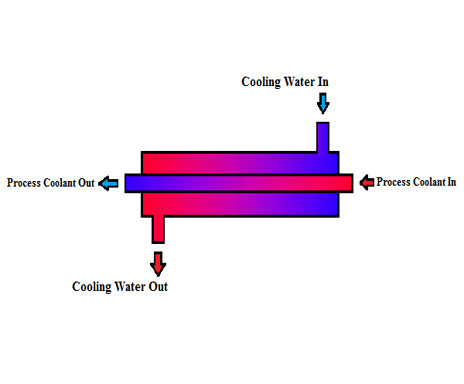
02 Cooling by Heat Exchanger — Cooling Tower Water
Water Cooled HEX

Cooling by Heat Exchanger — Cooling Tower Water

Process coolant is cooled by cooling tower water using shell & tube / plate type heat exchanger.
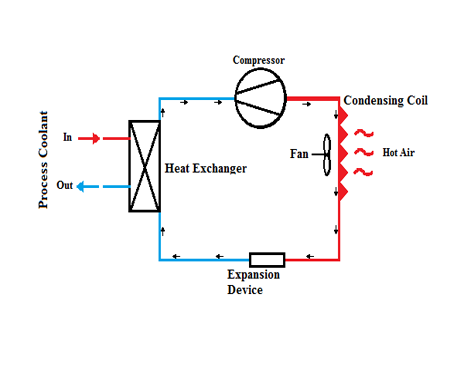
03 Cooling by Refrigeration System — Chiller
Refrigeration Chiller

Cooling by Refrigeration System — Chiller

When the required coolant temperature is below ambient, process coolant is cooled by refrigeration system.

Chiller Selection Chart
Engineering Guide

How to Select Your Chiller

Use the selection chart to identify the right chiller type and capacity for your application. Cross-reference with the heat load calculation below for precise sizing and specification.

Engineering Reference

Calculation of Chiller Heat Load

Selecting proper recirculation chiller based on following factors:
Q
Heat Load — the heat load generated by the process being cooled (Kcal/hr)
Tout
Outlet Temperature — maximum temperature of the process coolant exiting the process (°C)
Tin
Inlet Temperature — required temperature of the process coolant entering the process (°C)
d
Density — density of the coolant (Kg/m³)
Cp
Specific Heat — specific heat of the coolant (Kcal/Kg °C)
F
Flow Rate — available process coolant flow rate (Kg/hr)
Heat Load Formula
Heat Load (Q) = F × d × Cp × (Tout − Tin)

Cool Down & Safeguard
Your System

Talk to our engineering team — we'll help you select the right chiller for your exact process application.

Product Catalogue Capacity Calculator Talk to an Expert Service Assistance
Chat with us